

Proposal: Transform LUCAS into LOCUST — America’s Decisive Swarm Weapon
L.O.C.U.S.T - Low-cost Offensive Combat Unmanned Swarm Technology
“Speak softly and carry a big stick; you will go far.”— Theodore Roosevelt, 1901
The Department of War should immediately evolve the LUCAS (Low-cost Uncrewed Combat Attack System) into LOCUST (Low-cost Offensive Combat Unmanned Swarm Technology).
Swarm technology is the Achilles’ heel of any Iron or Golden Dome defense system. How can our defense system intercept 500,000 drones flying in coordinated waves toward the homeland? There is simply no way current-generation defenses could counter saturation of this magnitude, which is why the United States must recognize this reality and begin scaling manufacturing immediately.
LOCUST swarming would become the Department of War’s flagship drone initiative. Capable of overwhelming any aerial defense system in any country, it achieves dominance simply by launching enough drones that there are not enough interceptors to engage them all. A LOCUST swarm would serve as a devastating tactical weapon, comparable to nuclear bombs of the previous era—while doubling up as the most effective tool to neutralize the defense systems of any geopolitical adversary of the United States, including China, Russia, Pakistan, and Cuba.
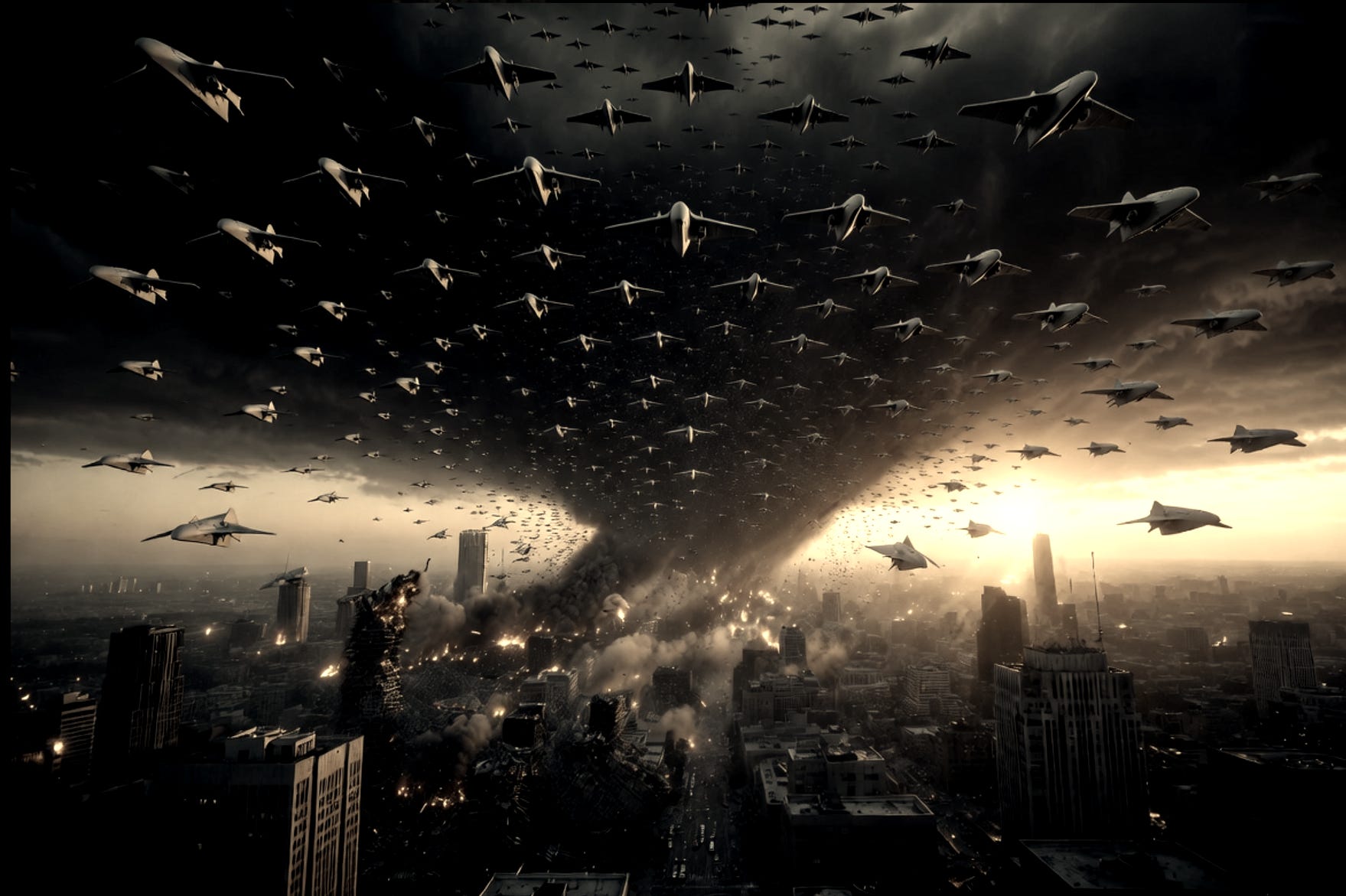
Beyond its direct military effect, LOCUST serves a vital psychological purpose: using imagery to frighten adversaries into submission. The mushroom cloud symbol of the nuclear bomb once produced a similar deterrent effect, yet its use has become so stigmatized that it is now reserved strictly for last-resort scenarios.
Imagine the scene from the enemy’s perspective. You look over the horizon and notice a dark cloud approaching. At first it resembles a rainstorm, but as it draws nearer you realize it is composed of thousands upon thousands of tiny dots moving in perfect unison, so dense it blots out the sun. As the city’s aerial defenses activate, it becomes clear the entire sky is filled with drones—and that those defenses will not matter. The LOCUST swarm begins to descend on the target, systematically wiping out everything in its path until every building, bunker, and blade of grass is gone and nothing remains.
A system like LOCUST would serve as a powerful deterrent. The locust swarm is one of humanity’s oldest and most terrifying symbols, especially among generations of farmers who have watched their fields devoured in mere hours. It represents unstoppable invasion and total devastation—a merciless horde that consumes everything without pause or pity. Once descended, the effects are apocalyptic: in mere hours, billions of locusts can strip every leaf, crop, blade of grass, piece of bark, and even wooden structures or fabric.
For thousands of years—through the Biblical eighth plague of Egypt, the prophet Joel’s war-horse imagery, and real mega-plagues such as the 1874–77 Albert’s Swarm—the Locust has stood as the universal metaphor for any overwhelming, swarm-like force that arrives in irresistible numbers and consumes all resources in its wake.

This symbol is a perfect fit for today’s military-technology trend: the shift from a few large, expensive weapons to vast numbers of cheap, versatile ones manufactured at massive scale. A single drone is like a single grasshopper—limited damage, easily intercepted, no real threat. If you multiply a single drone by 500,000, it becomes an unstoppable force that strikes terror into the heart of any enemy.
Lessons from Ukraine and Russia
The ongoing Russia-Ukraine conflict has provided the clearest real-world validation of swarm tactics. Russian electronic-warfare jamming has repeatedly neutralized GPS-dependent drones, yet Ukrainian forces have shown that mesh networking and vision-based AI navigation allow swarms to persist and adapt even under heavy interference. High attrition rates are expected and acceptable when unit costs are low; the key insight is that quantity overwhelms quality. Russian air defenses, including S-400 systems once considered impenetrable, have been saturated and exhausted by waves of cheap drones and decoys. These lessons directly inform LOCUST: by stripping out jam-vulnerable systems and relying on collaborative autonomy, we turn the adversary’s own electronic-warfare strengths into liabilities while driving their interceptor costs into the unsustainable range.
Counter-Swarm Integration: Layered Offense-Defense Dominance
While LOCUST is built as an offensive system, it integrates seamlessly with U.S. defensive counter-drone capabilities to deliver full-spectrum dominance. Pairing offensive swarms with proven technologies such as the Navy’s LOCUST directed-energy laser, high-power microwave systems, and AI-directed kinetic interceptors creates layered protection. LOCUST drones can serve dual roles—striking deep targets while simultaneously acting as decoys or electronic jammers that draw enemy fire and reveal their defensive positions. In a peer conflict, our swarms would saturate and exhaust an adversary’s defenses, buying time for U.S. counter-swarm assets to neutralize any incoming threats. This offense-defense synergy turns the swarm era into an asymmetric advantage for the United States rather than a mutual vulnerability.
Development Roadmap (18–24 Months to Full Swarm Capability)
The roadmap focuses relentlessly on quantity over quality, leverages proven technology, and spreads production across every willing defense contractor. Speed and scale are paramount.
Phase 0: Develop the System
Officially evolve the LUCAS system (Low-cost Uncrewed Combat Attack System) into LOCUST (Low-cost Offensive Combat Unmanned Swarm Technology).
Retrofit existing LUCAS airframes with mesh-networking nodes, stripped-down inertial plus vision-based AI targeting (eliminating expensive jam-prone GPS), modular commercial-off-the-shelf electronics, and basic collaborative-autonomy software.
Drawing directly from Ukraine-Russia lessons, the AI-vision system mirrors NASA’s Ingenuity helicopter on Mars: each drone carries a pre-loaded map of its flight path, updates its position using onboard cameras, landmarks, and accelerometers, and adjusts in real time until terminal impact.
Leverage ongoing Gauntlet testing at Fort Benning/Yuma for rapid iteration.
Output: First “LOCUST 1.0” swarm-capable units by mid-2026.
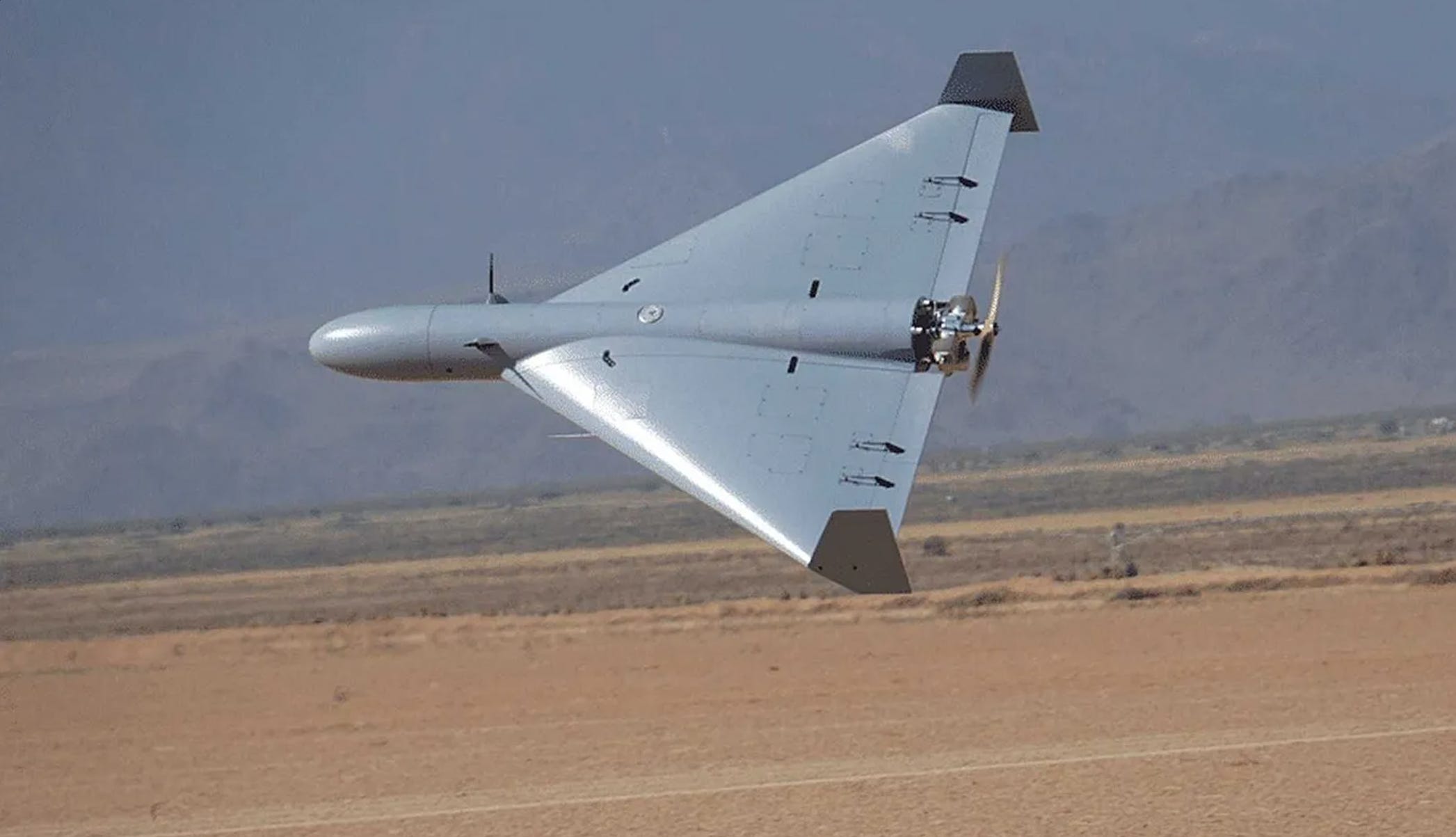
Phase 1: Swarm Optimization & Mass-Launch (Q2–Q4 2026)
Complete the full decentralized AI system so drones self-organize into altitude-layered waves, share targeting data via mesh networking, collaboratively evade defenses, and saturate 180° horizons.
Optimize for psychological “horizon-covering” effect with 1,000+ simultaneous launches per truck or ship. Containerized mass launchers are already in advanced R&D.
Further simplify: 3D-printed composites, low-cost piston-engine copies, minimal sensors, and modular warheads sourced from multiple vendors.
Test at scale with 10,000-drone waves to validate saturation against Patriot- and Iron Dome-style defenses.
Output: LOCUST 2.0 at $5k–$10k per unit; first operational squadrons trained in true swarm tactics.
Phase 2: Cost Crash & Million-Unit Scale (2027)
Shift to wartime-surge production involving 20+ vendors plus Army depots.
Drive unit costs down through volume, commercial-off-the-shelf parts, and ultra-stripped designs (inertial + AI mesh only).
Add advanced features iteratively: multi-altitude layering, repeated waves, and psychological “endless cloud” effects.
Output: Hundreds of thousands fielded; stockpiles ready for repeated 50,000–200,000-drone operations. An aggressive push could reach 1 million total inventory.
Phase 3: Doctrinal Integration & Continuous Evolution (2027+)
Arm every Army squad, Marine unit, Navy ship, and Air Force detachment.
Train operators on “swarm command-and-control” (one human overseeing hundreds when jamming is absent).
Iterate rapidly via feedback from exercises and combat, accelerating Ukraine/Russia lessons.
End-State Vision
By late 2026, initial LOCUST swarms (thousands per operation) will be fielded at $5k–$10k per unit. By 2027, the United States will possess full horizon-covering capability with 50,000–200,000-drone waves and hundreds of thousands of units in inventory. By 2028 and beyond, million-drone stockpiles will enable repeatable “unconditional power” strikes cheaper than a single F-35 squadron. At $5k per unit, a 100,000-drone swarm costs roughly $500 million—less than one Tomahawk salvo. A single carrier equipped with containerized launchers could generate a 50,000-drone wave at a fraction of current strike-package costs, delivering overwhelming effect anywhere on the globe. With several million units stockpiled, the United States could blot out the sky repeatedly against any adversary, restoring deterrence through sheer, visible, unstoppable mass. This is not merely an upgrade—it is the decisive leap into the swarm era.
500,000 LOCUST drones, or one B2. Which one would you choose?